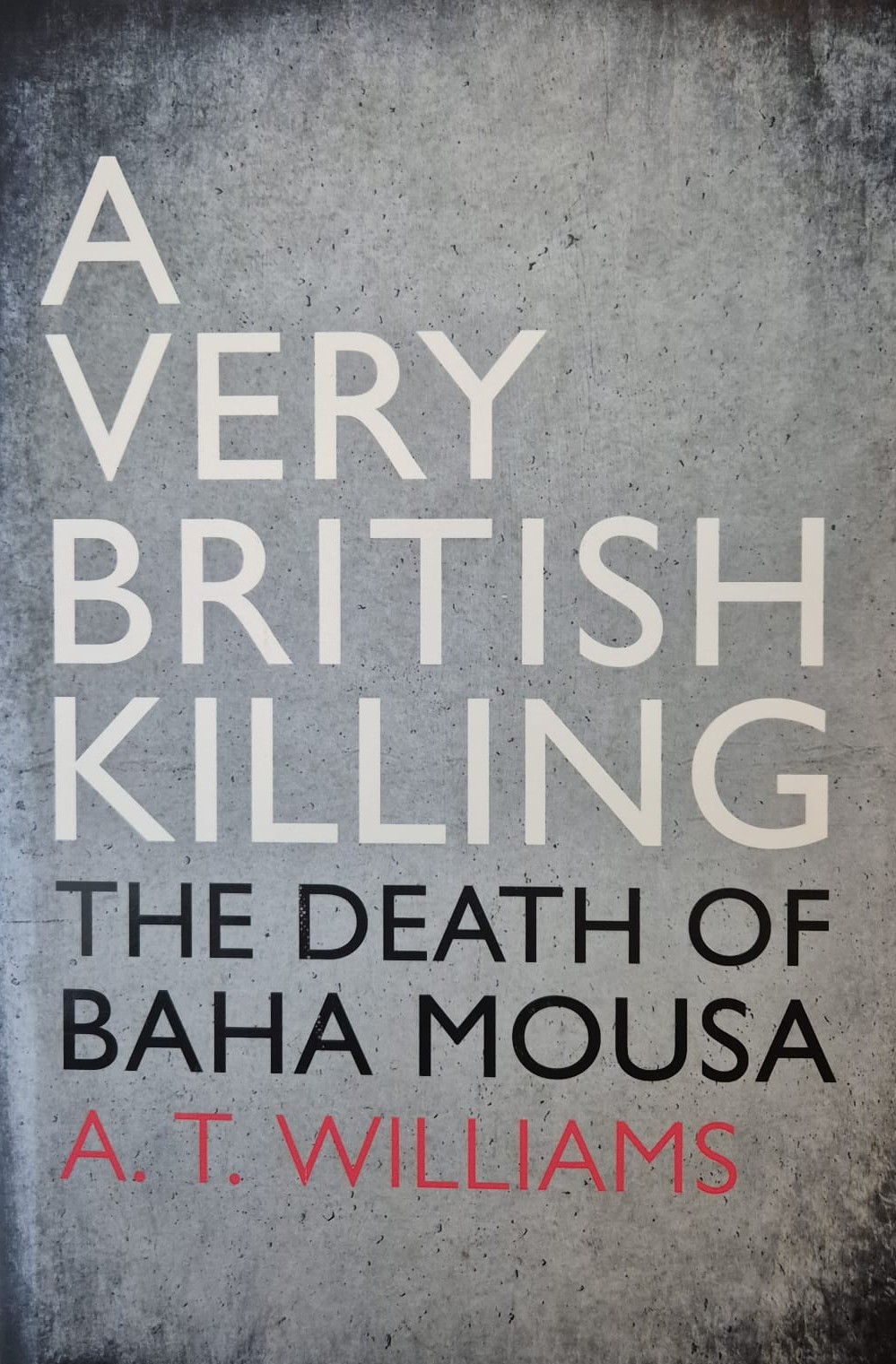
In September 2003, British soldiers in Anzio Company, in the First Battalion Queen’s Lancashire Regiment, beat an Iraqi civilian to death; his name was Baha Mousa, and he was a 26-year-old father-of-two, who worked as a hotel receptionist in Basra. In addition to killing Mousa – an act which the International Criminal Court concluded constituted the war crime of wilful killing/murder1The Office of the Prosecutor, Situation in Iraq/UK – Final Report, International Criminal Court, 2020, 31-32 – eight other Iraqi civilians were brutally tortured by these soldiers.2Situation in Iraq/UK – Final Report, 39 The events took place at Battlegroup Main, a British military base in Basra. Britain had illegally invaded Iraq, alongside the US, in March 2003. While the US focused on the northern and central zones of Iraq, Britain occupied the south and set up a network of interrogation and detention facilities there to secure its occupation. Britain was no stranger to this territory, having also invaded Iraq, then part of the Ottoman Empire, from the south during World War One.
The Baha Mousa Inquiry, published in 2011, found that at least nineteen British soldiers directly perpetrated detainee abuse in this case,3Situation in Iraq/UK – Final Report, 78 and that “a large number of soldiers witnessed the abuse but did not intervene to stop it, nor even report it up the chain of command”.4W. Gage, The Report of the Baha Mousa Inquiry: Volume I, London: The Stationery Office, 2011, 329 Only one soldier – Corporal Donald Payne – has ever been convicted of taking part in the abuse; he was sentenced to a year in prison.5The Report of the Baha Mousa Inquiry: Volume I, 329
The BBC has noted that “the Ministry of Defence always argued that [Mousa’s] death was the work of a few bad apples.” In fact, when one reads Professor A.T. Williams’ invaluable book, A Very British Killing: The Death of Baha Mousa, one finds that a more accurate description would be of a rotten barrel in the British Army, with only a few ‘good apples’ trying to do the right thing against the prevailing culture.
A Rotten Barrel
Williams – who is a Professor of Law at the University of Warwick, where he is also Co-Director of the Centre for Human Rights in Practice – observes that senior officers in the First Battalion Queen’s Lancashire Regiment were aware of detainee abuse, and failed to stop it. This included Captain Gareth Seeds and Major Christopher Suss-Francksen, who both visited the detention centre while the abuse was ongoing. Even though Seeds opposed the treatment of the detainees and tried to help them – he cut their cuffs and allowed them to use the toilet – he nonetheless departed from the detention centre after doing this and left the detainees alone with their abusers for eight more hours; during which time various forms of physical and psychological abuse continued.6A.T. Williams, A Very British Killing: The Death of Baha Mousa, London, Jonathan Cape, 2012, 31 He did not report the abuse that he witnessed to the Royal Military Police. Suss-Francksen entered the building, saw the detainees cuffed, curled up and in pain, and left without doing anything to help them.7A Very British Killing, 32
Williams further notes that Lieutenant Colonel Jorge Mendonça, who was the commanding officer of the regiment, didn’t even examine Mousa’s corpse after finding out that he died in the custody of his men; didn’t check on the other detainees; didn’t go to see the regiment’s doctor who had examined Mousa’s corpse; and didn’t enter the block where detainees were being held.8A Very British Killing, 38 He simply “went to bed”.9A Very British Killing, 38
Shockingly, Williams describes how a senior officer – Major Michael Peebles – was involved in directly perpetrating egregious detainee abuse. The youngest detainee at Battlegroup Main was a teenage boy, who was subjected to a punishment that Peebles orchestrated along with a non-commissioned officer, Staff Sergeant Mark Davies; Peebles called it a “naughty schoolboy routine”.10] A Very British Killing, 280 This consisted of the boy being forced to sit in front of an extremely loud generator as it blasted out hot air and pierced his ears with noise, while the soldier guarding him drank coffee and laughed at him.11A Very British Killing, 280 The boy was plasticuffed, hooded, and shirtless during this routine, as revealed by the Baha Mousa Inquiry.12The Report of the Baha Mousa Inquiry: Volume I, 95, 238, 242 Several soldiers saw this, and none of them intervened. Peebles and Davies have never been prosecuted for orchestrating this abuse against their teenage victim.
Britain’s Ministry of Defence revealed to this author, through a Freedom of Information request, that Britain’s Service Police Legacy Investigations determined that four allegations in relation to command responsibility in the Baha Mousa case met the Evidential Sufficiency Test – meaning there was enough evidence to bring it to trial. Nonetheless, no prosecutions followed from the Service Policy Legacy Investigations concluding this. The police’s determination was that one or more senior officers “either knew, or owing to the circumstances at the time, should have known that the forces were committing or about to commit such offences (under the International Criminal Court Act 2001)”, and also “failed to take all necessary and reasonable measures within his power to prevent or repress their commission or to submit the matter to the competent authorities for investigation and prosecution”. In addition, the Service Police Legacy Investigations concluded that the Evidential Sufficiency Test had been met for a senior officer directly perpetrating “ill-treatment”. The reason that none of these individuals have been prosecuted, according to the Service Police Legacy Investigations, is due to “no realistic prospect of a conviction”.
This culture of complicity extended further into the Royal Military Police itself. Williams describes how Captain Nugent, the Royal Military Police officer in charge of investigating deaths, only assigned a junior officer to investigate what happened, the day after hearing about Mousa’s death.13A Very British Killing, 42 This officer was Staff Sergeant Sherrie Cooper; during her visit to the detention centre, she took no photographs of the crime scene, spoke to no witnesses in depth, and collected no useful evidence.14A Very British Killing, 45 She didn’t even speak to Sergeant Charles Colley, the resident Royal Military Police officer at the base.15A Very British Killing, 45 By this point, the surviving detainees were no longer there, as they had been transferred.
Not discussed by Williams, but laid out in the Baha Mousa Inquiry, is how a soldier in the Royal Military Police actually witnessed detainee abuse in the detention centre while it was ongoing, and did nothing to stop it. This soldier, Corporal Claire Vogel, witnessed detainees groaning in pain while being forced to do exercise, in a room that reeked of human waste; and yet she did nothing to stop what was going on, nor even report it up the chain of command.16The Report of the Baha Mousa Inquiry: Volume I, 293-294, 297 This was a soldier whose responsibility it was to investigate detainee abuse, directly witnessing it and failing to act.
Williams details how even the medical personnel attached to Anzio Company were complicit in the abuse. Three army doctors saw detainees hooded in stress positions; they performed routine medical checks on these detainees, declared them fine, and then left the building, without reporting anything.17A Very British Killing, 89 Dr. Derek Keilloh, who was called to resuscitate Baha Mousa after he stopped breathing, failed to report the more than ninety injuries on Mousa’s body, and failed to properly examine the other detainees even after becoming aware that abuse had been occurring.18A Very British Killing, 261 Keilloh was later struck off from the medical register in 2012, after a General Medical Council panel concluded that he was guilty of misconduct in relation to how he behaved after Mousa’s death.
Appallingly, the regiment’s chaplain, Father Peter Madden, also failed in his responsibilities to report abuse. Williams explains that Madden never once checked on the welfare of detainees, even though he saw detainees hooded in stress positions, and heard raised voices in the detention centre.19A Very British Killing, 258 Williams describes how Madden passionately praised Mendonça at the 2006 court martial proceedings for being “scrupulously fair… it was a good regiment, a happy regiment”.20A Very British Killing, 259 Madden argued at the proceedings that in terms of how far a chaplain can intervene when witnessing something immoral, “when it came to operational matters the unit chaplain had no right to overrule command decisions. He might censure, offer his advice, but that was the extent of his role”.21A Very British Killing, 260 Williams notes that “Father Madden hadn’t even gone that far”.22A Very British Killing, 260
Madden’s gross negligence helped to perpetuate the detainee abuse that was going on; he was supposed to be a moral/spiritual guide, and yet he did not even censure the soldiers when he directly witnessed detainee abuse. This essentially gave legitimacy to the soldiers’ actions. Ian Cobain, in his book Cruel Britannia: A Secret History of Torture, quotes one of the soldiers who witnessed Corporal Donald Payne subjecting detainees to ‘The Choir’ – a technique of abuse where the detainees would be lined up and physically assaulted in sequence, causing them to emit screams akin to a twisted choir. This soldier says that he felt uncomfortable, but did not object to what was going on, because of the general groupthink and the fact that even Madden seemed to be okay with how the detainees were being treated at the time:
To be honest, when he first did it [Payne’s choir], I was uncomfortable and there was… other people were there, and other people laughed and maybe I just laughed along with them. I think maybe deep inside I knew it was wrong and it was upsetting, so I just went along with it. And I just remember it because I thought, well, even the Padre [Madden] has visited and even he – is he going to say anything? And he didn’t mention anything. So when people like that have come in, of high authority, you start to think, well, if I was going to report it who – is anyone bothered? I don’t know. So that’s why I was worried about reporting it.23I. Cobain, Cruel Britannia: A Secret History of Torture, London, Portobello, 2012, 240-241
Williams details how a media operations crew in a separate unit, consisting of soldiers who were involved in filming a publicity video at the base, also witnessed ‘The Choir’ – in addition to detainees being hooded, screamed at, and forced into stress positions. These soldiers from the media operations crew all failed to report the abuse.24A Very British Killing, 69-70 One of them inquired about the disgusting smell in the detention centre, to which a soldier in Anzio Company responded matter-of-factly that the detainees had “pissed and shat themselves. Wouldn’t you, with bags on your head and all that shouting?”.25A Very British Killing, 82
A Few ‘Good Apples’
Williams explains that there were a few soldiers who took their moral and legal obligations seriously. One was Lieutenant Commander Crabbe, who was based at Camp Bucca at the time. The surviving detainees were transferred to Camp Bucca after being tortured at Battlegroup Main; upon arriving there, Crabbe was appalled by their injuries26A Very British Killing, 45-46 – which included a detainee on the verge of death due to renal failure.27A Very British Killing, 12 The detainees received medical treatment at Camp Bucca, and Crabbe made a complaint about their injuries. It was only because of Crabbe’s intervention that a full crime scene investigation subsequently took place at Battlegroup Main. If Crabbe had not been there – if it had been another officer who was willing to turn a blind eye to the evidence of abuse – it is likely that no such investigation would have even taken place. This illustrates how the prospect of any form of accountability for war crimes – even extremely limited accountability, as in this case – is dependent on the odd chance that there is an individual willing to do the right thing, which is a rare occurrence.
Another soldier who behaved honourably was a young ex-Private named Jonathan Lee; Williams describes how he wasn’t cut out for army life and absconded to be with his girlfriend and hang out with his friends. As a result, he spent 56 days in an army jail.28A Very British Killing, 254 He was the only one in the company who made an effort to tell the truth at the 2006 court martial proceedings about the abuse that he witnessed; the other soldiers simply closed ranks, hence why almost all of them were released without charge.29Situation in Iraq/UK – Final Report, 78 He detailed brutal, sadistic violence inflicted on detainees at Battlegroup Main, and at another British military base (Camp Stephen) in Basra.30A Very British Killing, 252-253 He had initially reported what he witnessed to his doctor in 2004, who was treating him because he was depressed about what he had seen in Iraq; his doctor helped to put him in touch with the Royal Military Police, and his testimony then became part of the investigation into Mousa’s death.31A Very British Killing, 253 The defendants’ lawyers – the most senior barristers in Britain – relentlessly attacked him on the stand, using personal attacks to undermine his character, and he persistently resisted them.32A Very British Killing, 255
Williams says of Lee’s performance at the court martial proceedings: “Jonathan Lee spent a day and a half rebutting allegation after allegation. His fortitude before the prolonged assault was remarkable, a tour de force of resistance to the pressure applied by some of the most senior criminal law barristers working the courts today”.33A Very British Killing, 255 Nonetheless, his testimony was not sufficient to secure convictions of the overwhelming majority of soldiers who perpetrated abuse in this case; these soldiers escaped accountability for what they did, through backing each other up on the stand.34A Very British Killing, 241-243
Williams also discusses Lieutenant Colonel Nicholas Mercer – a senior army lawyer who witnessed hooded Iraqis being forced to kneel in the sand at Camp Bucca, in the blazing heat.35A Very British Killing, 257 He deemed it illegal and tried to fight to stop it, but other senior army lawyers disagreed and argued that such treatment was legal.36A Very British Killing, 258 Williams notes that when Mercer left Iraq in the summer of 2003, determined opposition to hooding and stress positions left with him.
These were essentially the only ‘good apples’ in a thoroughly rotten barrel, from Williams’ account.
In another notorious case of British soldiers abusing Iraqi civilians in 2003 – that of Camp Breadbasket, where British soldiers in the First Battalion Royal Regiment of Fusiliers physically assaulted Iraqi civilians, stripped them naked, and forced them to simulate oral and anal sex – there were actually no good apples from among the ranks of the soldiers themselves. The International Criminal Court has stated the following:
Several notable features stand out from the Camp Breadbasket court martial. First, although multiple military personnel knew about the alleged abuses (including the alleged sexual crimes), each failed in their duty to report them. The conduct only came to light when one of the soldiers involved in taking trophy photographs had the photographs developed in a civilian shop and the shop assistant reported the conduct to civilian police, who made an arrest.37Situation in Iraq/UK – Final Report, 37
Four low-ranking soldiers were subsequently given minor sentences for service disciplinary offences38Situation in Iraq/UK – Final Report, 84 – those who perpetrated the worst crimes in this case, involving sexual violence, have never been prosecuted.39Situation in Iraq/UK – Final Report, 37 In a similar, more recent display of impunity, in 2024 Israeli soldiers who were filmed, in leaked footage, gang-raping a Palestinian man in Israel’s notorious Sde Teiman detention centre have not been indicted for rape or sexual abuse, but rather solely for physical abuse – despite the fact that the detainee in question suffered a ruptured bowel and severe injury to his anus during the assault. The indictment even says that one of the soldiers stabbed the detainee in his rectum – which is an acknowledgment of rape, despite this not being one of the charges levelled at the soldiers, who are all yet to be prosecuted in Israel’s military courts. Tellingly, one former British soldier who served in the Royal Regiment of Fusiliers, who said of the Camp Breadbasket court martial: “just a shame the regiment decided to prosecute our heroes…that court martial was a load of shite”, has also posted in support of Israel during the Gaza genocide.
In the case of Camp Breadbasket, it was only because of a young woman who was working at the photography shop – a 22-year-old named Kelly Tilford – that the abuse ever came to light. Tilford stated: “I felt sick when I looked at the pictures. They were grim. I just felt awful.” Again, Tilford was a good apple; another shopworker might not have reacted as she did. For example, an ex-soldier posted on a British Army forum that a friend of a friend took trophy photographs in Basra featuring dead Iraqis, and sent them to the British shop Boots to be developed; the shopworkers at Boots did not call the police (even though taking trophy photographs of corpses is illegal), but actually developed the photographs and simply covered the faces of the dead Iraqis with stickers. This illustrates how it is actually a rare sort of individual who does the right thing in these circumstances.
Britain’s Long Legacy of Abuse and Unaccountability
Williams affirms that justice was not done in the 2006 court martial proceedings: “The case was finished. A twelve-month sentence for one man. Everyone else was free to return to duty or their civilian occupation. It was as if Battle Group Main hadn’t existed…”.40A Very British Killing, 270
No prosecutions have resulted from the subsequent 2011 Baha Mousa Inquiry.
Williams describes Britain’s pattern of behaviour – official rhetoric designed to conceal the true nature of British military conduct, and investigations set up that simply function as a fig leaf while abuses continue:
Protestations that Britain respects and promotes human rights and the laws of war have been accompanied by civilian and military commanders who do everything they can to look the other way or even bury cases of abuse. Systems of criminal investigations have been established to pursue those responsible, but they are not impartial, independent or effective. Official handwringing and apology have been joined by decisions and tactics preventing proper and full examination of those same crimes and others which are similar. And claims that the rule of law governs official action have been accompanied by deliberate attempts to avoid legal scrutiny. All in all the approach is very ‘British’: apologetic but ultimately disdainful of the suffering of people living in distant countries.41A Very British Killing, 2
Williams observes in regard to the long record of British atrocities in Kenya, Aden, Northern Ireland, Cyprus, Palestine, Malaya, and elsewhere, that not every soldier who served in these conflicts “was or is guilty. But who could argue convincingly that ‘Britain’ wasn’t responsible for these wrongdoings?”.42A Very British Killing, 291 For example, British soldiers tortured detainees in Aden in the 1960s by stripping them naked as a form of humiliation, forcing them to do exercise, and forcing them to urinate and defecate on themselves; in Northern Ireland in the 1970s, British soldiers subjected detainees to hooding, stress positions, and loud noise from generators. These techniques were all later used by British soldiers against detainees in Iraq. British political ministers and military officials have acted to perpetuate these abuses, have failed to prevent them, and have failed to ensure that justice has been done afterwards. What was done in Iraq was simply the latest in a long line of British military abuses for which accountability has been lacking.
The real strength of Williams’ book is that, alongside the macro-analysis of how British institutions were complicit in the atrocities, it never loses sight of the human beings at the centre of this story; Baha Mousa, his abused compatriots, and their families. Mousa left behind two small children named Hassan and Hussein, who have had to grow up without a father. I cried as I read how Williams describes Mousa’s final, agonised words as he was being tortured to death, related by another Iraqi man who was tortured alongside him: “My children, my children, I am going to die…”.43A Very British Killing, 204
This book is a compelling, harrowing, and well-researched investigation into a deeply shocking incident – an incident that was, in fact, far from unique in terms of the British Army’s conduct in Basra following the 2003 invasion.44The International Criminal Court has concluded that at least seven Iraqi civilian detainees were victims of the war crime of wilful killing/murder at the hands of British soldiers, perpetrated between April and September 2003. See: Situation in Iraq/UK – Final Report, 31-32 A soldier who served in the Queen’s Lancashire Regiment in Basra stated that his colleagues’ physical assaults of Iraqi civilians “just seemed to be the norm”. Another who served in the Black Watch Regiment in Basra stated that his colleagues’ practice of throwing Iraqi civilians into the Shatt-al-Arab River when they had allegedly been caught looting “was, I would say, a standard form of punishment”, and that “soldiers approved the use of the practice”. While another soldier who served in the Black Watch Regiment in Basra stated that “[s]tress positions were used commonly” by his colleagues against Iraqi civilians who had been detained for ‘looting’; the Black Watch Regiment was also authorised to hood these captured civilians. I have written about evidence that soldiers in Britain’s Joint Forward Intelligence Team routinely used sexual humiliation against Iraqi detainees at the Shaibah Logistics Base in Basra.
Williams notes that it is as if “those days of beatings and kickings and humiliations in a sweat-drenched Basra had never occurred”45A Very British Killing, 270 – but they did occur. And it is incumbent upon all of us to ensure that this incident and all the other incidents of British Army-perpetrated abuse in Iraq are not simply buried or forgotten; so that we can continue fighting for justice in these cases, and so that we can ensure that these abuses are not continually repeated wherever British soldiers are deployed. To that end, this book is an indispensable contribution.
Irfan Chowdhury is a freelance writer and PhD student at the University of Brighton. His PhD is titled: ‘How systematic were the British Army’s war crimes in Iraq between 2003 and 2009? An investigation into Britain’s abuse of underage Iraqi boys’. He has had articles published in Declassified UK, Middle East Monitor, Bella Caledonia, Iraq Now, Mondoweiss and others.